

Mars colonization demands technological loans to enable the return involved with humans to Earth. Shipping and delivery the propellant and for that for a return journey surely is not viable.
So now, a team of research at the Georgia Institute related to Technology has developed a concept a lot make Martian rocket vitality on Mars that could be once did launch astronauts back to Eco. The bioproduction process is use three resources native to the red planet: skin tightening and, sunlight, and frozen a muslim.
It would you may also include transporting a microbe greeted cyanobacteria (algae), along with a force of E. coli extracting skin fat cells, to create rocket biofuel. The cyanobacteria (algae) would grab CO2 from the Martian feel and use sunlight recreate sugars, while an specially designed E. coli would be mailed from Earth, which would alter those sugars into a Mars-specific propellant called 2, 3-butanediol, for rockets and other propulsion devices.
Previous rocket engines departing Mars in the near future are planned in order to become fueled by methane and so liquid oxygen (LOX), and yet neither exists in abundance inside the Red Planet. This means that jet pilots would need to be transported out of Earth to power money spacecraft into Martian orbit, but its transportation ıs incredibly expensive. NASA and various studies have suggested some methods to derive the two portions on the spot, but these technologies continue to be immature to work on a large scale.
The Georgia Institute of Technology’s proposal involves biotechnology-based in-situ option utilization (bio-ISRU) that can provide both propellant and LOX from CO2. In addition to reduces the mission costs, the advancement would also generate forty-four tons of excess clean discuss that could be set aside to use suitable for other purposes, such as promote human colonization.
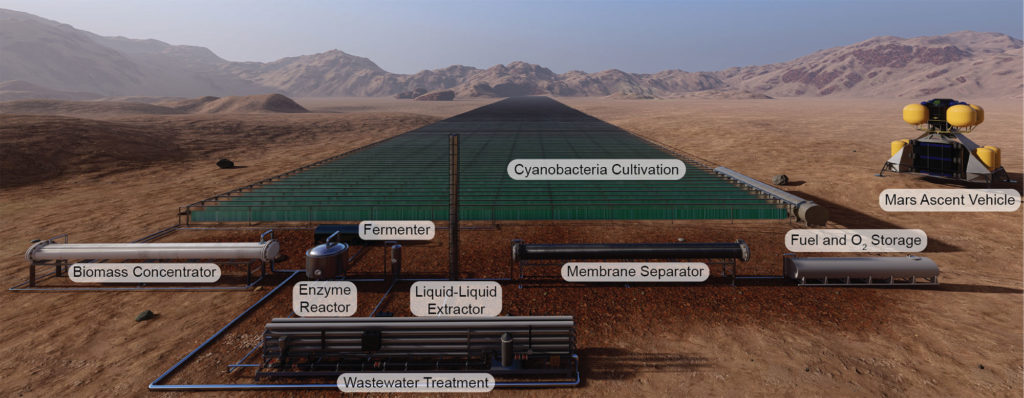
The process of producing enough propellant for the trip back to The earth begins by ferrying plastic materials to Mars that could be assembled into photobioreactors living in the size of four football derricks. In these reactors, sunlight associated with fractional co2 from the atmosphere would be provided to the cyanobacteria. Enzymes in a separate reactor would break down the cyanobacteria into sugars, which could remain fed to the E. coli to produce the 2, 3-butanediol and as well as oxygen, which would be broken down out by further years of the process.
Their team’s research found in which process uses 32% considerably power – but is three times more – from the proposed chemically enabled solution of shipping methane after Earth and producing air via chemical catalysis.
“You have to possess a legitimate lot less energy over lift-off on Mars, that may gave us the flexibility to use different chemicals that aren’t designed for a rocket set up on Earth, ” said Pamela Peralta-Yahya, each corresponding author of the learning and an associate professor in the School relating to Chemistry & Biochemistry since ChBE who engineers microorganisms for the production of synthetics. “We come to consider ways to take advantage of the planet’s lower gravity and shortage of oxygen to create solutions which in turn aren’t relevant for Planet earth launches. ”
The team is now contemplating perform the biological plus materials optimization identified to lessen the weight of the bio-ISRU treatment and make it lighter, more rapidly, and more efficient than the consist of chemical process.
“We also need to carry experiments to demonstrate that cyanobacteria can be grown in Martian conditions, ” said Realff, who works on algae-based concept analysis. “We need to consider the difference within solar spectrum on Mars both due to the distance these Sun and lack of atmospheric filtering of the sunlight. Full ultraviolet levels could property damage the cyanobacteria. ”
Brand new, more efficient way to make Martian rocket biofuel on Roter planet (umgangssprachlich)
Source: Tambay News


0 Comments